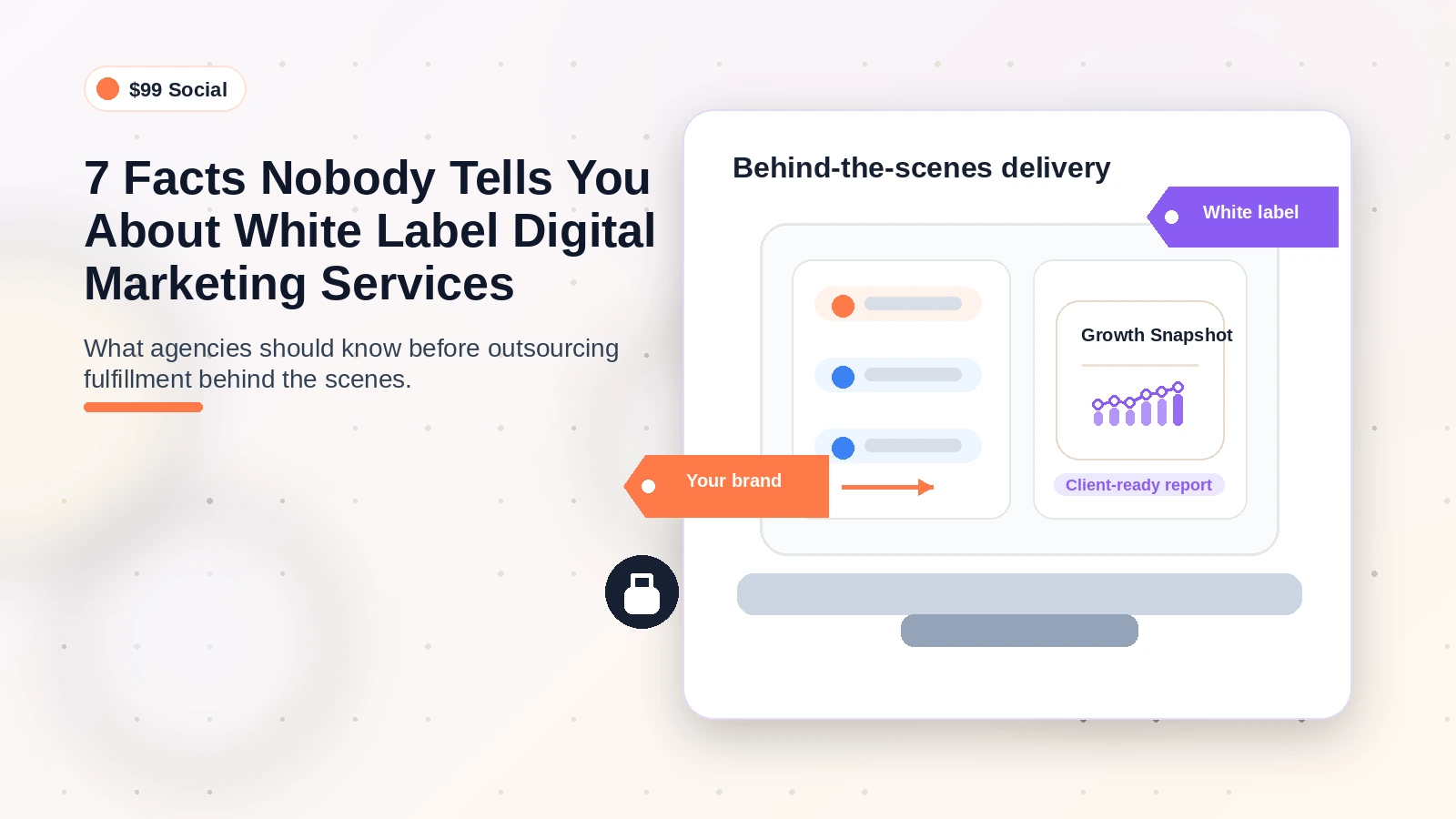
White label digital marketing has a slightly mysterious reputation: services fulfilled by one company, sold under another company's brand, with the client none the wiser. If you're a consultant, freelancer, or agency owner considering the model, you've probably read plenty of pitches about "scaling effortlessly." What you read less often is how the model actually behaves once real clients and real money are involved.
Here are seven facts about white label digital marketing services that the sales pages tend to leave out - the good ones and the uncomfortable ones.
1. Your clients genuinely don't care who does the work
New resellers agonize over this: isn't it dishonest that I'm not doing the posting myself? Then they notice that no client has ever asked. Businesses hire outcomes, not org charts - the same way they don't ask which contractor their builder subcontracts. Your restaurant client wants a full calendar of good content and more customers walking in. Whether it was produced by you at midnight or by a fulfillment team is simply not their problem, as long as you own the relationship and stand behind the quality.
2. This is how much of the industry already operates
The polished agency you're competing against? There's a decent chance parts of its fulfillment - content production, ad management, SEO deliverables - are white labeled too. Outsourced fulfillment behind a branded front is one of the industry's oldest structures, not a shortcut for beginners. The difference between agencies is rarely whether work is outsourced; it's how well the front-end operator manages strategy, communication, and quality control.
3. The margins are real - but they're earned on the relationship
Buying fulfillment at wholesale and reselling at 2-3x is a genuinely good business. What the pitch decks skip: the margin compensates you for the part that's still yours - selling, setting expectations, translating client feedback, and keeping the relationship healthy. White label removes production from your plate, not accountability. Resellers who treat the margin as passive income churn clients; resellers who treat it as payment for account leadership keep them for years.
4. Quality varies wildly between providers
This is the single biggest risk in the model. Some white label social media partners run experienced content teams with real editorial standards; others resell the cheapest possible gig work, and in 2026 a new tier has appeared - providers who pipe raw, unedited AI output straight into client accounts. Your brand absorbs every bit of that quality, whichever tier you picked. Before committing, always review real content samples, test the service on your own accounts first, and check how revisions and turnarounds actually work when something misses the mark.
5. "Unbranded" is a spectrum - check the details
White label should mean your clients never see the provider's name: reports carry your logo, dashboards live under your domain, and nobody emails your client from an address you don't control. In practice, providers differ on every one of those points. Before signing, confirm exactly what's brandable - reports, client portals, communication - and what isn't. The moment a client discovers a third party by accident, you've converted a trust advantage into a trust problem.
6. You can sell services you couldn't personally deliver
A solo consultant can't personally be excellent at social media management, short-form video, paid ads, and SEO at once - but can credibly sell all of them with the right fulfillment behind each. That's the quiet superpower of the model: your service menu is no longer limited by your own skill set, and cross-selling an existing client a second service is far easier than finding a new client. The flip side: never sell what your partner can't show you samples of. Your credibility is the collateral.
7. The model rewards focus, not volume
Because fulfillment scales without hiring, new resellers assume the goal is maximum clients, any clients. The ones who actually build wealth with white label services almost always narrow instead: one or two industries they understand, a defined offer, pricing with real margin, and clients who renew for years. Ten well-chosen clients at a healthy markup beat thirty bargain clients who churn - in revenue, in stress, and in referrals. White label removes the production ceiling; what you do with that freedom is still strategy.
The honest summary
White label digital marketing is neither a scam nor a money printer. It's a division of labor: a fulfillment partner handles production, you handle trust. If you choose a provider with verifiable quality, keep ownership of the client relationship, and price like a professional, it's one of the most capital-efficient ways to build a marketing business in 2026. Skip any of those three, and the model's weaknesses find you quickly.